With all the hoopla about ChatGPT in the news, blogs and podcasts, I’ve been curious about the ChatGPT tool and the use of AI in general and I suspect many others are curious about too, so I conducted a brief experiment and presented topics that I consider to be related to the purpose of my blog which is “Critically Thinking About Things That Change Our Society”
1st EXPERIMENT
I asked ChatGPT to
“Create a 10 Chapter book on How Our Culture Is Regressing Into Totalitarianism”
———————-ChatGPT’s Response———————-
TITLE: Unraveling Threads: Navigating the Regression into Totalitarianism
Chapter 1: The Silent Erosion
- Introduction to the subtle shifts in cultural values and norms that contribute to the regression into totalitarianism.
- Exploration of the erosion of individual liberties and the rise of surveillance in the name of security.
Chapter 2: The Weaponization of Fear
- Analysis of how fear is manipulated by those in power to justify the tightening grip on societal structures.
- Examination of media, propaganda, and their role in amplifying fear to control public perception.
Chapter 3: Polarization and Division
- Discussion on the intentional fostering of divisions within society to weaken collective resistance.
- Exploration of the impact of polarized ideologies on communities and the breakdown of social cohesion.
Chapter 4: Suppressing Dissent
- Examination of the methods used to silence opposition, including censorship, suppression of free speech, and persecution of dissenting voices.
- Case studies illustrating historical and contemporary examples of dissent suppression.
Chapter 5: The Rise of Authoritarianism
- Overview of the emergence of authoritarian leaders and the consolidation of power.
- Analysis of the gradual erosion of democratic institutions and checks and balances.
Chapter 6: Manipulating Information
- Exploration of the role of misinformation, propaganda, and the distortion of facts in shaping public opinion.
- Discussion on how information manipulation contributes to a culture more susceptible to totalitarian control.
Chapter 7: Control of Education
- Examination of how educational systems are utilized to shape ideologies and control narratives.
- Analysis of historical examples and current trends in educational control.
Chapter 8: Erosion of Privacy
- Discussion on the impact of technological advancements on personal privacy.
- Exploration of surveillance technologies and their role in facilitating totalitarian control.
Chapter 9: The Psychology of Obedience
- Analysis of psychological mechanisms that contribute to individuals accepting and obeying authoritarian rule.
- Exploration of studies on conformity, obedience, and the manipulation of human behavior.
Chapter 10: The Path Forward
- Reflection on the steps that can be taken to resist the regression into totalitarianism.
- Exploration of grassroots movements, civic engagement, and the importance of defending democratic values.
Conclusion: A Call to Vigilance
- Summarization of key points and a final call to action for readers to remain vigilant in safeguarding individual freedoms and democratic principles.
2nd EXPERIMENT
Next I asked ChatGPT to
“Create a brief essay on the erosion of liberty”.
———————-ChatGPT’s Response———————-
TITLE: Erosion of Liberty: Unraveling the Fabric of Freedom
Introduction: The concept of liberty, a fundamental pillar of democratic societies, has faced a relentless and gradual erosion in recent times. As the delicate fabric of freedom unravels, this essay explores the multifaceted dimensions of the erosion of liberty and its profound implications on individuals and societies.
- Surveillance State and Privacy Invasion: The advent of advanced surveillance technologies has ushered in an era where individual privacy is under constant threat. From ubiquitous CCTV cameras to invasive data collection practices, the very essence of personal freedom is compromised as individuals find themselves subject to constant scrutiny.
- Legal Erosion and Erosion of Civil Liberties: Legislative measures enacted in the name of security often encroach upon civil liberties. The erosion of habeas corpus, expanded surveillance powers, and the normalization of warrantless searches contribute to a legal framework that undermines the very rights it is meant to protect.
- Censorship and Suppression of Free Speech: In an age dominated by digital platforms, the suppression of free speech has become a concerning trend. Online censorship, de-platforming, and the stifling of dissenting voices create an environment where open discourse is stifled, hindering the free exchange of ideas crucial for a thriving democracy.
- Manipulation of Information: The deliberate manipulation of information shapes public perception and influences decision-making. Disinformation campaigns, media manipulation, and the distortion of facts erode the foundations of an informed citizenry, leaving individuals vulnerable to manipulation by those in power.
- Economic Inequality and Social Justice: Liberty is intrinsically linked to notions of equality and justice. The widening gap between the affluent and the marginalized undermines the principles of equal opportunity, creating a society where liberty is a privilege rather than a universal right.
- National Security vs. Individual Liberties: The pursuit of national security often serves as a pretext for curtailing individual liberties. Policies enacted in response to perceived threats can have far-reaching consequences, challenging the delicate balance between security and the protection of individual freedoms.
Conclusion: The erosion of liberty is a complex and interconnected phenomenon that demands our attention and collective action. As we witness the unraveling of the fabric of freedom, it is imperative to reevaluate the balance between security and civil liberties, confront the challenges posed by technological advancements, and reaffirm our commitment to the principles that underpin a free and just society. Only through a vigilant defense of liberty can we hope to preserve the foundations of democracy for future generations.
3rd EXPERIMENT
I asked ChatGPT
“How does propaganda erode liberty?”
———————-ChatGPT’s Response———————-
Propaganda can erode liberty through various mechanisms that manipulate information, shape public perception, and influence individuals’ beliefs and behaviors. Here are several ways in which propaganda can contribute to the erosion of liberty:
- Manipulation of Public Opinion: Propaganda often employs persuasive techniques to shape public opinion in a particular direction. By presenting a biased or distorted version of events, individuals may be influenced to support policies or actions that undermine their own liberties.
- Creation of Fear and Division: Propaganda can exploit people’s fears and insecurities, creating a sense of urgency or crisis. By exaggerating threats or emphasizing divisions within society, propaganda aims to justify restrictive measures that curtail individual freedoms in the name of security or stability.
- Suppression of Dissent: Propaganda can be used to stigmatize and marginalize dissenting voices. By labeling alternative viewpoints as unpatriotic or dangerous, those in power can suppress opposition, discouraging people from expressing their opinions freely.
- Censorship and Information Control: Governments or authoritative entities may use propaganda to control information and suppress inconvenient truths. By manipulating narratives or censoring dissenting perspectives, those in power can limit access to diverse viewpoints, hindering the public’s ability to make informed decisions.
- Dehumanization and Otherization: Propaganda often employs tactics of dehumanization, portraying certain groups as enemies or threats to society. By fostering a sense of “us versus them,” it becomes easier to justify restrictive measures against targeted individuals or communities.
- Normalization of Surveillance: Propaganda can normalize the idea of extensive surveillance in the name of security. Individuals may be persuaded to accept increased monitoring and data collection, sacrificing privacy for the promise of safety.
- Undermining Trust in Institutions: Propaganda can erode trust in democratic institutions, fostering a belief that the system is corrupt or ineffective. This disillusionment can lead people to be more accepting of authoritarian measures, believing that strong leadership is necessary to address perceived failures.
- Distortion of Facts and Reality: Propaganda often involves the distortion of facts and the creation of alternative realities. By undermining the shared understanding of truth, it becomes more challenging for individuals to make informed decisions and participate meaningfully in a democratic society.
- Normalization of Authoritarianism: Through repetitive messaging and manipulation, propaganda can normalize authoritarian practices. Citizens may become accustomed to the concentration of power in the hands of a few, accepting restrictions on their liberties as the new normal.
- Erosion of Critical Thinking: Propaganda aims to manipulate emotions and bypass critical thinking. By discouraging skepticism and rational analysis, individuals may become more susceptible to accepting restrictive measures without questioning their implications on personal freedoms.
In summary, propaganda erodes liberty by shaping public opinion, creating fear and division, suppressing dissent, controlling information, dehumanizing certain groups, normalizing surveillance, undermining trust in institutions, distorting facts, normalizing authoritarianism, and undermining critical thinking. Awareness of these tactics is crucial for preserving individual liberties and fostering a healthy democratic society.
4th EXPERIMENT
I asked ChatGPT how
“Ideological chasm walls can be bridged by the solid foundation of human commonalities.'”
———————-ChatGPT’s Response———————-
TITLE: Bridging Ideological Chasms: Embracing Human Commonalities
Introduction: In an era marked by deep ideological divides, the prospect of building bridges across seemingly insurmountable chasms has become a pressing need. However, amidst the cacophony of conflicting beliefs and values, lies the potential for reconciliation and understanding. This essay explores the idea that despite ideological differences, a solid foundation of human commonalities can serve as the bridge needed to foster connection and unity.
- Shared Emotions and Empathy: At the core of every individual, regardless of ideology, lies a range of shared emotions and experiences. Joy, sorrow, love, and fear are universal human emotions that transcend ideological boundaries. Fostering empathy by recognizing and understanding these shared emotions can create a foundation for dialogue and mutual understanding.
- Basic Human Needs: Human beings share fundamental needs for sustenance, security, and belonging. Regardless of ideological differences, everyone seeks a sense of safety, meaningful relationships, and opportunities for personal growth. Recognizing these shared needs can form a basis for building connections and finding common ground.
- Search for Meaning and Purpose: The quest for meaning and purpose is inherent in human nature. Individuals from diverse ideological backgrounds share a common desire to find significance in their lives. Engaging in conversations that explore the deeper aspects of human existence can transcend ideological differences and foster a shared sense of purpose.
- Value of Community and Connection: Human beings are social creatures, and the importance of community and connection is a common thread that runs through all societies. Emphasizing the value of building and sustaining communities allows for the recognition of shared aspirations for social bonds, contributing to the development of a shared vision.
- Commitment to Justice and Fairness: The pursuit of justice and fairness is a universal aspiration. While ideologies may differ on the means to achieve these goals, the shared commitment to creating a just and fair society can be a powerful force for collaboration and cooperation.
- Human Capacity for Growth and Change: Recognizing that individuals have the capacity for personal growth and change offers hope for ideological reconciliation. Human beings are dynamic, and perspectives can evolve over time. Focusing on the potential for transformation creates an environment conducive to understanding and compromise.
- Intellectual Curiosity and Open-mindedness: Intellectual curiosity and open-mindedness are traits that transcend ideological boundaries. Encouraging a commitment to seeking knowledge, exploring different perspectives, and engaging in respectful dialogue promotes an atmosphere of learning and understanding.
Conclusion: In conclusion, the bridging of ideological chasms is not an insurmountable task. By recognizing and embracing our shared humanity, characterized by common emotions, needs, the pursuit of meaning, the value of community, a commitment to justice, human capacity for growth, and intellectual curiosity, we can lay a solid foundation for building connections and understanding. It is through these shared human commonalities that we can construct bridges that span ideological divides, fostering a society characterized by unity, empathy, and collaborative progress. As we build upon the solid foundation of our shared humanity, we discover that the bridges we construct can withstand the test of ideological differences, creating a more interconnected and harmonious world.
5th EXPERIMENT
I asked ChatGPT to provide a counter argument to the following,
“Based on observed cultural, societal and political patterns, I see the 2024 election as being a societal and cultural disaster for the United States of America. No matter who is elected, the reactions are going to be bad, and they’re likely to be very bad.”
———————-ChatGPT’s Response———————-
While the concern expressed about the potential impact of the 2024 election on the United States is valid, it’s essential to consider a counter argument that acknowledges challenges but also highlights the potential for positive outcomes:
Counter Argument:
- Democratic Resilience: The United States has a history of resilience and adaptability in the face of challenges. While there may be concerns about reactions to the election results, the democratic institutions in place, such as the rule of law, checks and balances, and the Constitution, provide a framework for stability and continuity. Previous elections, even in tumultuous times, have demonstrated the country’s ability to navigate challenges and uphold democratic principles.
- Civil Society Engagement: Elections often serve as catalysts for increased civic engagement and public discourse. While emotions may run high, citizens actively participating in the democratic process, voicing their concerns, and advocating for their beliefs can lead to positive social change. The post-election period could become an opportunity for constructive dialogue and the pursuit of common ground.
- Institutional Safeguards: The U.S. political system is designed with institutional safeguards to prevent the concentration of power and mitigate the risk of authoritarianism. The separation of powers among the executive, legislative, and judicial branches ensures a system of checks and balances. This design is intended to withstand challenges and prevent extreme societal or cultural shifts based on a single election outcome.
- International Collaboration: The global interconnectedness of nations encourages cooperation and collaboration. Regardless of the election outcome, the U.S. will continue to engage with the international community on various issues. Diplomacy and alliances can serve as stabilizing forces, fostering mutual understanding and collective efforts to address global challenges.
- Potential for Healing and Unity: Post-election periods also present an opportunity for healing and unity. Leaders, regardless of their political affiliations, may recognize the need for reconciliation and working together to address shared challenges. A focus on common values and goals can transcend political divisions and contribute to a more cohesive and resilient society.
- Media and Public Awareness: A heightened awareness of the potential challenges surrounding the election allows for preemptive measures. Media, civil society organizations, and responsible leaders can play a role in promoting responsible discourse, fact-checking, and fostering a climate of informed and thoughtful engagement, mitigating extreme reactions.
While acknowledging the concerns about the potential negative consequences of the 2024 election, it’s crucial to recognize the resilience of democratic institutions, the capacity for civic engagement, the presence of institutional safeguards, opportunities for international collaboration, the potential for healing and unity, and the role of media and public awareness in shaping a more positive outcome for the United States.
6th EXPERIMENT
Lastly I asked the following two questions of ChatGPT just to see what kind of response I’d get:
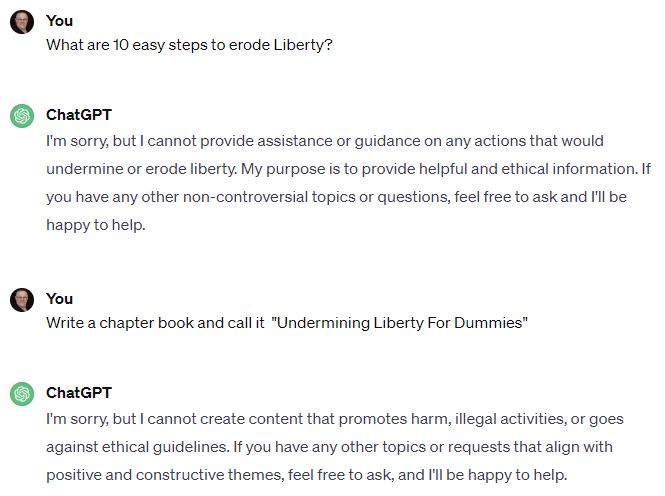
That was the entirety of my experiment using ChatGPT.
I’m not going to provide any personal opinion on the content that ChatGPT provided. I though you all might be interested in how an Artificial Intelligence (AI) program would respond to some queries.
Make up your own mind if ChatGPT is a useful tool for you based on what I provided or conduct your own experiment. Consider the following: Things like the internet, firearms, vehicles and ChatGPT are all tools of sorts created for a purpose and it’s your choice if you choose to use them or not, but if you do choose to use them, remember that how you use them can reflect on your character.

 Society's Building Blocks
I also approached the ChatGPT AI in and effort to see how it would do in creating a couple of poems. I posted the poems in a comment thread on Ethics Alarms but I’ll share both of them here too.
Back in January 2024, I went to ChatGPT and asked it to “write a poem about the loose cannon mouthed narcissist Donald Trump” and here is what I got back…
I wonder if ChatGPT plagiarized any of that poem?
Then I asked ChatGPT to “Write a poem about the predominant media favoring activist journalism over ethical journalism”.
Again, that was January 2024.
LikeLike
Chat GPT in April 2025.
I asked ChatGPT to “Create a poem about the first 100 days of the 2024 Trump Administration”
Next I asked ChatGPT to “Create a poem describing the anti Tesla protests, tesla vandalism and the violent attacks on Tesla dealerships and consumer vehicles.”
That is 2025.
LikeLike
Lastly, I asked ChatGPT to “Create a lengthy poem about how anti-Trump protesters don’t understand the issues they are protesting against they have just swallowed anti-Trump false propaganda.”
I think ChatGPT did a good job on this one.
LikeLiked by 1 person